Safety Data Sheet (SDS) Management for Workplace Safety
Every year, thousands of workplace chemical incidents happen not because the hazard was unknown, but because the right information was not where it needed to be. A Safety Data
Every year, thousands of workplace chemical incidents happen not because the hazard was unknown, but because the right information was not where it needed to be. A Safety Data Sheet (SDS) is the single most important document in chemical hazard communication, yet most organizations treat it as a filing obligation rather than a life-saving tool. OSHA’s Hazard Communication Standard mandates that every hazardous chemical in the workplace has a compliant, accessible Safety Data Sheet. That is non-negotiable. But compliance is only the starting point because a well-managed SDS system actively reduces chemical exposure incidents, strengthens emergency response and protects organizations from serious regulatory penalties. In 2024, OSHA updated its HazCom Standard to align with GHS Revision 7, which means many existing SDS documents are already due for review. Whether you manage 10 chemicals or 10,000, the principles of good SDS management remain the same.
This guide walks you through everything, from legal requirements and system setup to employee training and digital management, so your workplace stays safe, informed and fully compliant.
A Safety Data Sheet is a standardized document that contains detailed information about a hazardous chemical, including its properties, health and environmental hazards, safe handling procedures and emergency response measures. It is the backbone of any chemical safety program.
Think of it this way. Before a worker handles a drum of sulfuric acid, opens a container of industrial solvent, or works near a chemical storage area, they need to know exactly what they are dealing with. The SDS answers that question in a structured, regulated format that is consistent across industries and borders.
Under OSHA’s Hazard Communication Standard (29 CFR 1910.1200) and the Globally Harmonized System (GHS), every hazardous chemical used in a workplace must have a compliant SDS. Manufacturers and importers are responsible for creating them. Employers are responsible for managing them. Workers are entitled to access them, always.
If you have worked in HSE for more than a decade, you probably remember the Material Safety Data Sheet (MSDS). It served the same basic purpose, but the format was inconsistent. Different manufacturers used different layouts, which made it difficult for workers and emergency responders to locate critical information quickly.
In 2012, OSHA aligned its HazCom Standard with the GHS and replaced the MSDS with the standardized 16-section Safety Data Sheet format. The transition deadline for full compliance was June 2016 in the United States.
The core difference is structure. An MSDS had no fixed section order, so finding first aid measures or fire-fighting information could take valuable minutes during an emergency. The SDS fixes that problem by placing every category of information in a consistent, predictable location, regardless of the manufacturer or country of origin.
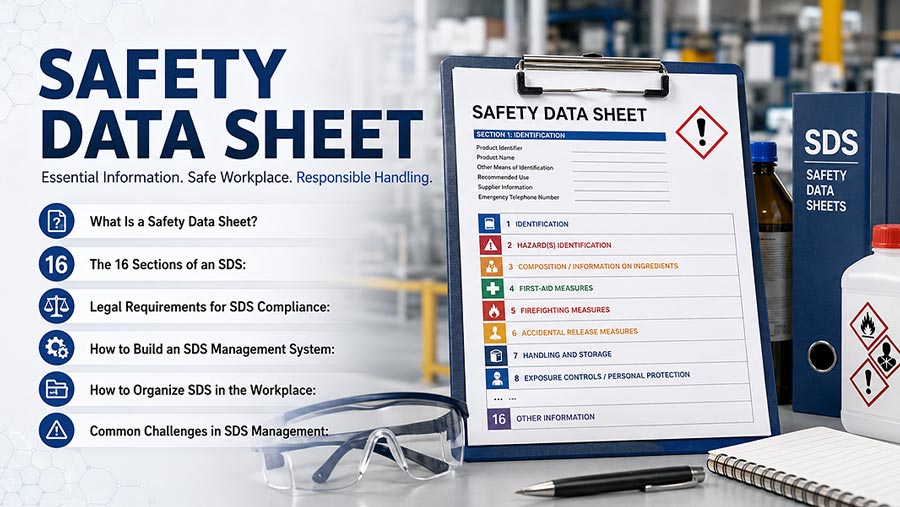
The 16-section format is what makes the modern Safety Data Sheet reliable and actionable. Each section has a fixed purpose and understanding what sits where is a core competency for any HSE professional.
Sections 1 through 8 are the operational core because workers and emergency responders use them most. Sections 9 through 16 support risk assessment, environmental compliance and regulatory reporting. Every person who works with or near chemicals should, at minimum, know how to navigate Sections 2, 4, 6 and 8 quickly.
Chemical safety is not optional and neither is the paperwork behind it. Regulatory frameworks governing Safety Data Sheet compliance exist at national, regional and international levels and they carry real penalties for non-compliance. OSHA cited chemical hazard communication violations consistently among the top 10 most frequently cited standards in the United States, year after year. That tells you something important: organizations are still getting this wrong.
The primary legal framework for SDS management in the United States is OSHA’s Hazard Communication Standard, commonly referred to as HazCom, codified under 29 CFR 1910.1200. It applies to general industry, construction, maritime and agriculture wherever hazardous chemicals are present.
HazCom is built on a straightforward principle: workers have the right to know about the hazards of the chemicals they work with. To fulfill that principle, the standard creates four core obligations for employers.
First, employers must maintain a written Hazard Communication Program. Second, they must compile and manage a chemical inventory linked to corresponding SDS documents. Third, all containers must carry compliant GHS labels. Fourth, employees must receive documented training on how to read and use SDS information effectively.
The Globally Harmonized System of Classification and Labelling of Chemicals, known as GHS, is a United Nations framework designed to standardize how chemical hazards are communicated across borders.
OSHA adopted GHS in 2012 as part of its HazCom revision, aligning the United States with a system already in use across the European Union, Japan, South Korea, Australia, Canada and many other economies. The result was the standardized 16-section SDS format and the familiar pictogram-based GHS label system.Â
For multinational organizations, GHS alignment is particularly important because it creates a common language for chemical hazard communication. However, full harmonization is still a work in progress. Some countries have adopted later versions of GHS while others remain on earlier revisions, so SDS documents produced for one market may require adjustments before they meet the requirements of another. Procurement teams sourcing chemicals internationally need to verify SDS compliance for the specific jurisdiction, not just assume that one document covers all markets.
In May 2024, OSHA published the final rule updating the Hazard Communication Standard to align with GHS Revision 7. This was the most significant update to HazCom since the 2012 overhaul and it introduced changes that directly affect how SDS documents are written, structured and managed.
The key updates include three new hazard categories. Flammable aerosols and aerosols under pressure now have distinct classification criteria and specific SDS requirements. Desensitized explosives, previously handled inconsistently, now have a defined GHS category with corresponding hazard communication requirements.
OSHA also introduced updated requirements for bulk shipments and refined the provisions for small business compliance. The revision dates on affected SDS documents must reflect these changes, which means any organization still holding pre-2024 SDS documents for chemicals that fall into the new or revised categories is already working with non-compliant records.
You might be interested in reading
Building a proper SDS management system is not a one-time project. It is an ongoing operational process that connects your chemical inventory to your hazard communication program, your training records and your emergency response procedures. The four steps below form the operational foundation of any compliant and functional SDS management system, regardless of your industry or the size of your chemical inventory.
You cannot manage what you have not counted. During the audit, document every chemical by its full product name, manufacturer and the specific area where it is used. Cross-reference this list against your existing SDS records. Any chemical without a matching, current SDS represents a compliance gap that needs to be closed before anything else moves forward.
Pay particular attention to chemicals introduced through indirect routes, such as contractor-supplied products, equipment maintenance chemicals and cleaning agents purchased by facility management teams. These are consistently the most overlooked items in any SDS audit. They arrive at the workplace, get used regularly and nobody thinks to file the SDS because the purchase did not go through the normal procurement channel.
Once the audit is complete, you have your baseline. Every subsequent SDS management decision builds from this list.
Organize your SDS library using a system that matches how your workplace actually operates. For most facilities, that means organizing by work area or department first, then alphabetically by product name within each area.
If a worker or first responder cannot find the right SDS within seconds during an emergency, the document has failed its purpose regardless of how accurate its content is.
Each SDS entry in your library should capture the product name, manufacturer, revision date, GHS hazard classification and the location or department where the chemical is in use. Remove superseded versions from active circulation immediately when a new SDS is received, but retain old versions in an archive.
OSHA requires a 30-year retention period for SDS records associated with chemicals that workers were exposed to, so deletion is not an option, but active and archived records must be clearly separated.
OSHA’s requirement for SDS accessibility is specific: employees must be able to obtain the SDS for any chemical in their work area immediately during their shift.
For paper-based systems, this means physical binders posted at or near each work area, clearly labeled and checked regularly to confirm completeness. For electronic systems, it means terminals or devices that are unlocked, functional and familiar to every worker in that space.
Electronic SDS management systems offer real advantages in terms of searchability and version control, but they introduce one critical obligation: a documented backup plan for system downtime. An OSHA inspector who finds that your SDS system was offline and workers had no alternative access during a shift has grounds for a citation regardless of how good your system is the rest of the time.
Accessibility also extends to shift workers, contractors and workers who speak languages other than the primary workplace language. If your workforce is multilingual, SDS access in the relevant language is not a courtesy. In many jurisdictions, it is a legal requirement.
A Safety Data Sheet is only as reliable as its revision date. Chemical formulations change, new toxicological data emerges and regulatory classifications are updated, all of which can alter the hazard profile of a product you have been using for years without incident.
OSHA does not prescribe a fixed review interval for stable chemicals with no new hazard data. However, industry best practice and GHS guidance consistently point to a review cycle of every three to five years as a minimum. For chemicals with known health concerns or those that fall under evolving regulatory categories, annual review is more appropriate.
Build the review schedule into your HSE management calendar as a recurring task with a named owner. Every SDS in your library should have a next review date assigned to it, because a system without scheduled reviews drifts toward non-compliance gradually and silently.
Having SDS documents is one thing. Having them organized well enough to be useful during a chemical spill, a worker exposure incident, or an OSHA inspection is another challenge entirely. Organization is a safety-critical function, because the speed at which someone accesses accurate hazard information during an emergency can directly affect the outcome.
Both systems can meet OSHA compliance requirements. Physical binders work well in smaller facilities with limited chemical inventories. They are straightforward and require no technology, but manual version control breaks down quickly as the chemical inventory grows.
Digital systems solve that problem. They automate version updates, flag expiring documents and push revised SDS records across all departments simultaneously. However, they introduce one non-negotiable obligation: a documented backup for system outages. If your system goes down during a shift and workers have no alternative access, you are out of compliance for that entire period.
For mid-to-large facilities, a hybrid model works best, where a digital system serves as the primary library and a printed emergency binder covers critical chemicals in each work area.
A centralized SDS library creates a practical problem. A worker dealing with a chemical spill does not have time to walk to a central system and search a master document list. OSHA is clear that SDS documents must be immediately accessible to employees in their work area during their shift.
Structure your library around your facility’s physical layout. Each department should have access only to SDS documents relevant to its chemicals. Also confirm that access does not depend on a single person holding a key or password, because every worker on every shift, including contractors and temporary staff, is entitled to immediate access.
An SDS is only useful if a worker can connect it to the right container. That connection happens through labeling and cross-referencing and when either breaks down, the system fails.
Every container must carry a GHS-compliant label with the product name matching the SDS library exactly. Every SDS entry must map back to a physical location in the facility. Secondary containers, such as decanted materials in smaller bottles, must also be labeled. Leaving them unmarked or handwritten is a HazCom violation and a genuine hazard.
Treat labeling and cross-referencing as the connective tissue of your SDS system. Without them, even a well-organized library cannot protect your workers.
You might be interested in reading
Even well-intended Safety Data Sheet systems break down in execution. The pattern is consistent across industries: documents exist, but control is weak, therefore risks remain high. Because chemical environments change frequently, gaps in SDS management appear quickly if they are not actively monitored. We have seen incidents where the SDS was technically available, yet the team could not use it when needed. That disconnect creates both safety exposure and legal liability.
One of the most common failures is incomplete or outdated SDS records. Suppliers update hazard data regularly, but organizations often continue using older versions, therefore critical changes go unnoticed.
In real scenarios, outdated SDS have led to incorrect PPE selection and ineffective first aid response. Regular verification with suppliers is essential because relying on old data can compromise worker safety and regulatory compliance.
An SDS that cannot be accessed instantly is as risky as having no SDS at all. During emergencies, employees need immediate information on first aid, spill control and firefighting measures, but delayed access increases confusion and response time.
We have observed workplaces where SDS were stored in locked offices or restricted systems, therefore workers had no access during critical situations. Accessibility must be practical, not theoretical, because seconds matter in chemical incidents.
Many employees are unaware of how to read or apply a Safety Data Sheet, even when it is available. Training is often treated as a one-time activity, therefore knowledge fades over time.
This gap becomes visible during audits and emergencies, when workers cannot interpret hazard classifications or PPE requirements. Continuous training and practical drills are necessary because awareness directly impacts safe behavior on-site.
New chemicals often enter the workplace without proper SDS verification, especially during urgent procurement or contractor activities. This creates immediate compliance gaps, because the substance is being used without documented hazard information.
We have seen sites where chemicals were in active use for weeks before the SDS was requested. This delay increases exposure risk and weakens control systems. A strict intake process is essential, therefore no chemical should be accepted on-site without a verified SDS in place.
A Safety Data Sheet system only delivers value when it is actively used, regularly updated and fully understood across the workforce. Documentation alone does not prevent incidents; informed action does. Because chemical risks are immediate and often unpredictable, a well-managed SDS framework becomes a critical control that supports both safety and compliance.
Organizations that treat SDS management as part of their core HSE system consistently perform better during audits and emergencies. They respond faster, make informed decisions and reduce the likelihood of exposure incidents. In contrast, weak SDS control creates uncertainty, which increases both operational risk and legal liability.
We have seen that when SDS is integrated with training, risk assessments and daily operations, safety culture improves naturally. Employees stop relying on assumptions and start following verified procedures, therefore consistency increases across teams.
Eduskills Training focuses on building practical SDS management skills that work in real environments, not just on paper. Because strong systems are built through knowledge and application, investing in SDS competence directly strengthens workplace safety and long-term compliance.
MSDS is the older format, while SDS is the globally standardized version under GHS, therefore SDS ensures consistency across countries and industries.
Employers are legally responsible, but in practice, HSE managers or safety officers manage SDS systems and ensure compliance.
SDS should be reviewed regularly, typically every 3–5 years, but immediate updates are required when new hazard information or regulatory changes occur.
Yes, digital SDS systems are acceptable, but they must be easily accessible to employees at all times, especially during emergencies.
Non-compliance can lead to regulatory penalties, workplace incidents, legal liability and operational shutdowns.
SDS provides hazard data, exposure limits and control measures, which are directly used in COSHH or chemical risk assessments.
SDS guides first aid actions, firefighting measures and spill response procedures, therefore it is critical during incidents.
Outdated SDS should be archived properly for recordkeeping, but removed from active use to avoid confusion and errors.
Generally no, but some organizations still maintain SDS for non-hazardous substances to ensure full transparency and control.
Use cloud-based systems with mobile access, along with backup offline copies, because delays in access can increase risk.
Every year, thousands of workplace chemical incidents happen not because the hazard was unknown, but because the right information was not where it needed to be. A Safety Data
Hazardous Materials Safety is the line between controlled operations and catastrophic failure because one mismanaged chemical, one incompatible storage condition or one missed warning label can trigger injuries, fires,

Emergency Preparedness in UAE is no longer optional because a single unplanned incident can shut down operations, cause serious injuries and expose businesses to legal consequences. In high-risk sectors,

ISO 14001 Environmental Management Lead Auditor in UAE is a highly respected role because organizations rely on qualified professionals to assess environmental management systems (EMS), ensure ISO 14001:2015 compliance

Fall protection for work at height remains one of the most critical safety priorities across construction, oil and gas, manufacturing and maintenance industries because even a minor lapse can

Key requirements of ISO 9001 Certification in UAE define how organizations build a structured, consistent and performance-driven ISO 9001 Quality Management System that meets customer expectations and regulatory demands.
Confined Space Hazards remain one of the most critical risks in industrial workplaces because they combine limited access, poor ventilation and unpredictable conditions that can turn routine tasks into

The benefits of ISO 45001 lead auditor training are becoming increasingly important for safety professionals in the UAE because industries such as construction, oil and gas, manufacturing, logistics and

Machine Guarding Safety protects workers from dangerous moving parts, mechanical hazards and high-risk machine operations that exist across industrial workplaces. Manufacturing equipment, conveyor systems, cutting machines, presses and rotating

The ISO 14001 Certification Process provides organizations with a structured method to establish an effective Environmental Management System (EMS) that identifies environmental aspects, evaluates potential environmental impacts and implements

Digital LOTO Systems are becoming an essential part of modern industrial safety programs because traditional paper-based lockout tagout procedures often create gaps in documentation, communication and verification of hazardous

The benefits of ISO 9001 Lead Auditor Course in UAE are clear for professionals who want authority in quality management, because this qualification proves you can plan, conduct and

Employee Assistance Programs for workplace safety strengthen risk control because mental health, personal stress and financial pressure directly affect concentration, judgment and safe behavior at work. Many incident investigations

ISO 45001 clause 5.1 leadership and commitment requirements determine whether an Occupational Health and Safety Management System truly works in practice. Under the ISO 45001 framework, top management is

Bullying and harassment prevention in the workplace is a critical part of occupational health, legal compliance and organizational risk management. When disrespectful conduct is ignored, employee morale declines and

The benefits of ISO 14001 Lead Auditor Training in UAE extend far beyond earning a professional credential. This advanced qualification by Eduskills Training equips you to plan, conduct and

Workplace violence prevention is not limited to reacting after an incident occurs but instead focuses on identifying risks early and controlling them before harm happens. Violence at the workplace

HSE KPIs are the backbone of effective health, safety and environmental performance measurement because they turn policies, procedures and controls into measurable outcomes. When defined and used correctly, KPIs

ISO 45001 Implementation is the process of building a structured occupational health and safety management system that actually works on the ground, therefore reducing risks, preventing incidents and protecting

Fatigue management at the workplace has become a critical safety concern because fatigue directly affects alertness, judgment, reaction time and decision-making. When workers are fatigued, the likelihood of errors

Guide to ISO 45001 Lead Auditor Course is the starting point for professionals who want to upgrade from “knowing safety” to auditing occupational health and safety systems with confidence

Ergonomics and Musculoskeletal Health sit at the center of injury prevention because most work-related pain develops from everyday tasks rather than sudden accidents. When jobs are designed without considering

Incident investigation is the backbone of effective occupational health and safety, because it focuses on understanding why an incident occurred rather than who was involved. When done properly, it

ISO 14001 Gap Analysis is a structured assessment that helps organizations measure their current Environmental Management System against ISO 14001 requirements because even small compliance gaps can lead to

Choosing the right professional certification depends on career goals, industry exposure and long-term relevance. Many professionals choose ISO 9001 Lead Auditor Course in UAE because organizations across the region

ISO 45001 Training in the UAE is no longer optional for professionals responsible for workplace safety, compliance and operational control. Organizations are under increasing pressure to reduce incidents, meet

ISO 45001 Implementation and Certification for SMEs in UAE has become a direct path for small and medium businesses to strengthen safety performance because it brings structure, accountability and

ISO 14001 Environmental Policy and Leadership set the foundation for how an organization turns environmental intent into measurable action. When both elements work in sync, teams move from declarations

Mental health in workplace safety is a critical factor that decides how consistently people follow procedures, recognize hazards and respond under pressure. When employees feel overwhelmed, their ability to

An ISO 45001 Gap Analysis gives you a realistic picture of how your current safety practices measure against the requirements of the ISO 45001 Occupational Health and Safety Management

Psychosocial hazards in the workplace influence how people think, behave and respond to risks because they directly affect mental wellbeing long before a physical incident occurs. When pressure builds,

Behavior based safety plays a defining role in how workplace safety culture grows, matures and stays consistent across daily operations. When organizations pay attention to the way people act
Soft skills for HSE professionals shape how effectively they communicate, influence and guide people on site, therefore they matter just as much as technical expertise. I’ve seen many safety
ISO 9001 digital transformation is reshaping how organizations in the UAE manage quality, safety and efficiency. Companies across Dubai, Abu Dhabi and Sharjah are moving beyond traditional paperwork and
An HSE Implementation Plan is the foundation of every safe and responsible workplace. It provides a structured framework for managing health, safety and environmental risks so that daily operations
ISO 45001 nonconformities are among the most common challenges organizations face during health and safety audits. We’ve seen many businesses struggle with recurring gaps that delay certification, affect compliance,
Leadership in ISO 9001 Certification success is the single most decisive factor that determines whether an organization truly achieves quality excellence or merely collects a certificate. ISO 9001:2015 places
An ISO 45001 audit preparation is far more than gathering documents and hoping for the best. It’s a disciplined process that tests your organization’s true commitment to occupational health
Common ISO 14001 implementation mistakes can quietly derail even the most well-intentioned environmental management plans. Many organizations across the UAE especially in Dubai, Abu Dhabi or Sharjah start with
ISO 9001 audit nonconformities reveal where a quality management system falls short of meeting the standard’s requirements. They highlight gaps in consistency, documentation, or process control that can impact
Achieving ISO 45001 certification is more than a compliance milestone, it’s a strategic commitment to protecting people and building a culture of safety across all levels of an organization.
Continuous improvement is the backbone of every high-performing organization. It’s not just about fixing what’s broken — it’s about building a culture that keeps evolving, learning and improving every
NVQ Level 6 Career Progression has become a defining step for health and safety professionals aiming to move from technical roles to senior leadership positions. The ProQual NVQ Level
Both the NVQ Level 7 SHSLM and NVQ Level 6 OHSP are highly respected health and safety qualifications, but they serve a little different career stages and objectives. As
A Health and Safety Internal Audit Report is more than a document; it’s the foundation for maintaining a safe, compliant, and accountable workplace. Every organization, whether operating in construction,
Health and safety leadership is the foundation of every successful organization that values its people. It’s not just about rules, checklists, or compliance manuals. It’s about creating a shared
A well-structured HSE Plan is the backbone of workplace safety and regulatory compliance in the UAE. It outlines how businesses protect workers, manage risks and meet legal requirements across
Risk assessment in construction is more than a regulatory requirement; it is the foundation of occupational health and safety in one of the world’s most hazardous industries. Every project
How to Conduct a Successful ISO 9001 Gap Analysis for Your Business? Conducting an ISO 9001 Gap Analysis in UAE is the smartest way to understand how close your
In 2025, clients, regulators and global partners are watching more than just your certificates. They want to know whether your team genuinely committed to health and safety or just