Top Forklift Hazards and Risk Control Measures in the Workplace

Forklift hazards and risk control is a critical responsibility in any workplace where powered industrial trucks operate daily. Warehouses, construction sites, manufacturing plants and logistics hubs rely on forklifts constantly. But that familiarity is exactly what makes them dangerous. When workers stop seeing a machine as a threat, accidents follow. According to the National Safety Council, forklifts were responsible for 84 work-related deaths in 2024 alone, with over 25,000 DART cases recorded in the same period. OSHA estimates between 35,000 to 62,000 forklift-related injuries occur every year in the United States. These are not random incidents. Most are preventable. Forklift hazards and risk control is not a box-ticking exercise for compliance audits. It is an operational responsibility that sits on the desk of every HSE manager, site supervisor and employer. Because when powered industrial truck safety fails, the consequences go far beyond a workers’ compensation claim. They include fatalities, OSHA penalties, production shutdowns and lasting damage to workplace safety culture.
This guide breaks down the top forklift workplace hazards, the real-world forklift risk control measures that work and what a structured forklift safety management approach looks like in practice. Whether you manage a small warehouse or a large industrial facility, what follows gives you the framework to protect your people and stay compliant.

What Are Forklift Hazards and Why Do They Matter?

Forklifts account for just 1% of all warehouse and factory accidents, yet they are responsible for 11% of all physical injuries in those same environments. That disproportionate impact is what makes forklift hazards and risk control a non-negotiable priority in any industrial setting. Understanding what these hazards are, why they persist and what they genuinely cost is the foundation of every effective workplace forklift safety program. Without that foundation, everything else, the checklists, the training, the PPE, becomes reactive rather than preventive.

What Is a Forklift Hazard?

A forklift hazard is any condition, action or environment that creates the potential for injury, damage or death during powered industrial truck operations. It can be mechanical, like a faulty braking system. It can be human, like an operator who skipped the pre-shift inspection. Or it can be environmental, like a wet warehouse floor with no drainage system in place.

Forklift operational hazards do not always announce themselves. A load shifted two inches off-center, a pedestrian stepping into a blind spot or a floor surface that looks firm but gives way under load, these are the conditions that turn routine tasks into serious incidents. Identifying a forklift hazard starts with understanding that the risk is not just the machine. It is the interaction between the machine, the operator, the environment and the systems in place to manage all three.

Why Forklift Incidents Still Occur?

OSHA estimates that roughly 70% of forklift incidents are preventable. So why do they keep happening?

The honest answer is that most workplaces treat forklift safety compliance as a one-time event rather than an ongoing process. Operators get certified, the paperwork gets filed and the daily reality on the floor gets little attention until something goes wrong. Fatigue and distraction contribute to over 40% of forklift accidents, regardless of how experienced the operator is.

Operator error accounts for approximately seven out of ten incidents, according to OSHA and NIOSH. But operator error rarely happens in isolation. It happens because supervision is inconsistent, refresher training is overdue or the workplace traffic management system has gaps nobody has addressed. The machine does not make mistakes. The system around it does. That is why forklift hazard identification must be built into daily operations, not saved for annual audits.

The Cost of Forklift Accidents:

The financial impact of a single forklift accident goes well beyond the initial injury. A single workers’ compensation claim for a forklift injury averages between $38,000 and $41,000 in direct costs alone. Factor in lost productivity, equipment repair, temporary labor, legal fees and rising insurance premiums and the total cost per incident can climb close to $190,000.

Then there are the regulatory costs. In 2024, OSHA penalties for forklift safety violations exceeded $8 million across US industries, with 2,248 citations issued under the Powered Industrial Trucks standard. A single willful violation can cost up to $156,259 per citation. One documented case resulted in proposed penalties of $288,299 from just twelve citations.

But no financial figure captures what a fatality costs a family, a team or a workplace. The human cost is permanent. That is precisely why forklift hazards and risk control deserves serious investment, not just a line item in a safety budget. Programs like those offered by Eduskills Training are built on this understanding, equipping HSE professionals and operators with the competency to prevent incidents before they happen, because prevention is always cheaper than consequence.

Every forklift workplace hazard has a pattern. A specific condition, a gap in procedure, a moment where something was overlooked. Understanding the most common forklift hazards and risk control failures gives HSE managers and supervisors the insight to act before an incident occurs rather than after. They are the hazards that OSHA investigators document repeatedly, across industries, every single year.

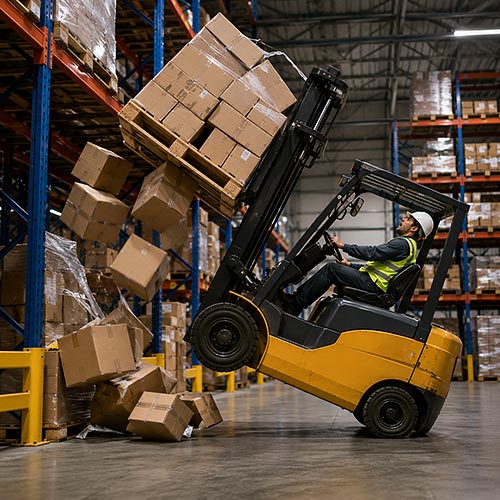
Forklift hazards and risk control during unsafe load handling as unstable boxes fall from an overloaded forklift in a warehouse.

Most Common Forklift Hazards at Work:

Every forklift workplace hazard has a pattern. A specific condition, a gap in procedure, a moment where something was overlooked. Understanding the most common forklift hazards and risk control failures gives HSE managers and supervisors the insight to act before an incident occurs rather than after. These are not hypothetical risks. They are the hazards that OSHA investigators document repeatedly, across industries, every single year.

Forklift Tip-Over Hazards:

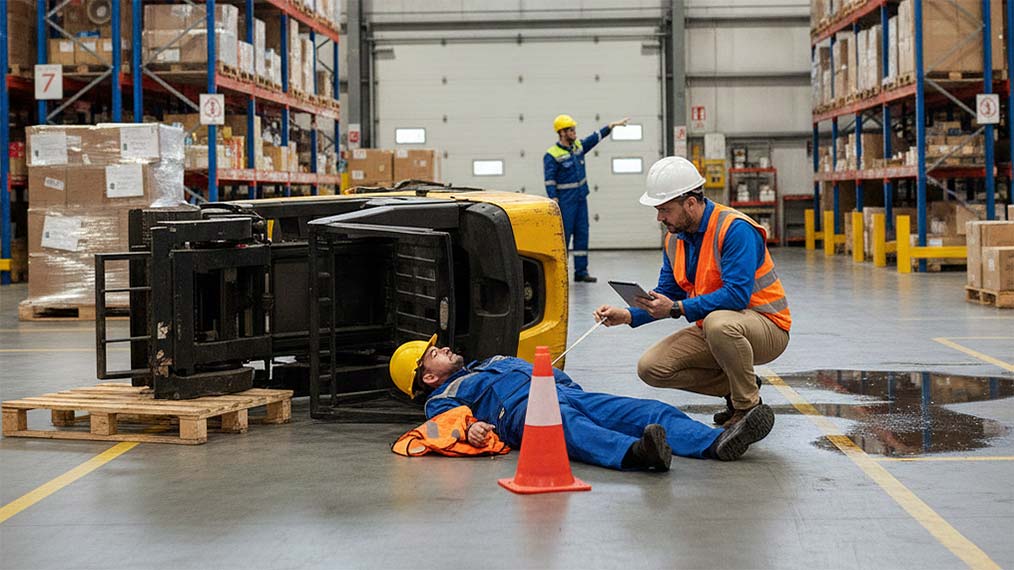
Tip-overs are the deadliest forklift operational hazard in any workplace. Approximately 42% of all fatal forklift accidents involve the operator being crushed when the machine tips over, according to OSHA. Sharp turns at speed, carrying an unbalanced or oversized load, driving on uneven surfaces and operating on inclines without proper precautions are the most common triggers.

What makes tip-overs particularly dangerous is operator reaction. Many operators instinctively try to jump clear of a tipping forklift, but that instinct is often fatal. The correct response is to stay inside the cab, grip the steering wheel firmly, brace both feet and lean away from the direction of the fall. The overhead guard is designed to protect the operator, but only if they stay inside it. Forklift stability hazards demand both equipment checks and trained instinct.

Pedestrian Collision Risks:

Pedestrians account for 36% of all forklift-related fatalities, yet they are often the most overlooked variable in forklift traffic management planning. A forklift weighs up to 9,000 lbs, which is three times heavier than an average car. At operating speed, a pedestrian struck by a forklift has very little chance of walking away without serious injury.

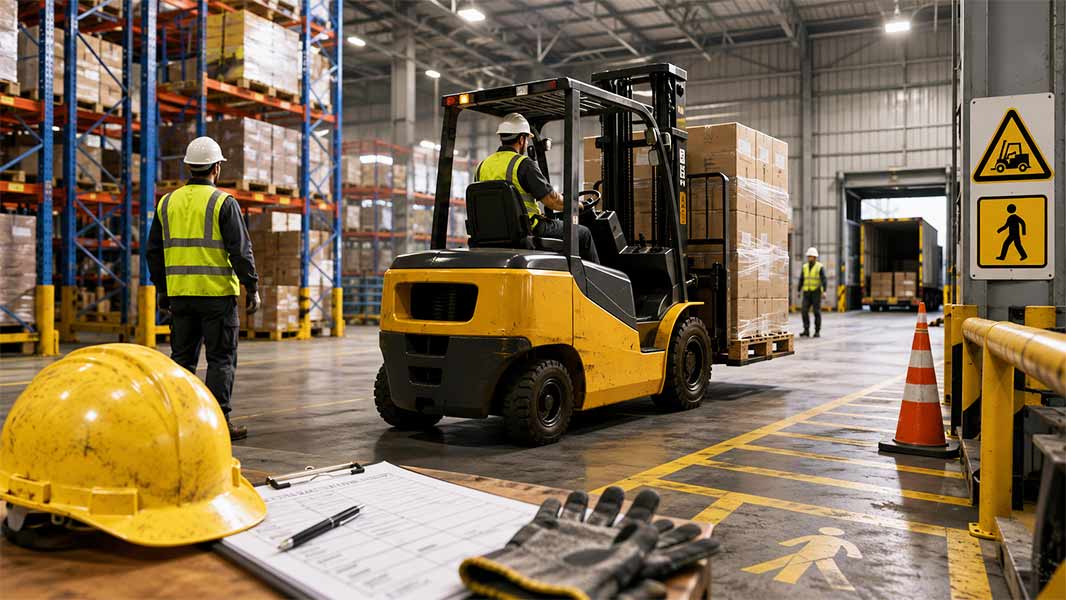
The problem is largely systemic. When pedestrian walkways are not physically separated from forklift travel lanes, when horns and warning lights are ignored and when operators develop a false sense of familiarity with the environment, collisions become a matter of when, not if. Workers with pedestrian forklift injuries take an average of 20 days to recover, the highest median for days away from work in any forklift incident category. Physical separation, visual warnings and strict pedestrian safety zones are non-negotiable controls.

Falling and Unstable Loads:

A load does not have to fall from a great height to kill someone. Even at low rack levels, a shifted or improperly secured pallet can crush a worker instantly. Unstable load hazards arise from poorly stacked pallets, damaged pallet boards, loads exceeding the rated capacity and cargo that shifts during travel because forks were raised too high in transit.

OSHA is clear that loads must be stable, safely arranged and within the rated capacity of the forklift before any movement begins. Traveling with an elevated load dramatically raises the center of gravity and increases tip-over risk simultaneously. Therefore, forks should be kept 6 to 10 inches above the ground during travel and loads must be secured or wrapped before lifting. Load stability management is one of the most direct ways to reduce serious injuries at the point of operation.

Speeding and Unsafe Driving:

Speeding is a leading cause of both forklift tip-overs and pedestrian collision incidents. Unlike road vehicles, forklifts have a rear-wheel steering system, which makes them highly responsive at low speeds but extremely difficult to control when driven aggressively. An operator taking a corner too fast on a loaded forklift is operating at the edge of the stability triangle with every turn.

OSHA does not set a universal speed limit for forklifts, but it requires employers to establish and enforce appropriate speed limits for their specific facility. Many facilities set limits between 5 and 8 mph in pedestrian zones. The reality, however, is that posted limits mean nothing without consistent enforcement. Workers on 12-hour shifts are 37% more likely to cause or be involved in an accident, because fatigue reduces both reaction time and judgment. Safe forklift driving practices must be enforced through supervision, not just signage.

Blind Spots and Poor Visibility:

Poor lighting alone accounts for 26% of forklift accidents, according to industry data. Add an elevated load blocking the operator’s forward sightline, a blind corner at an aisle intersection and a facility without convex mirrors or proximity sensors and the conditions for a serious collision are already in place.

Forklifts carrying large loads routinely obstruct the driver’s view to the front. In these situations, operators should travel in reverse, using the clear sightline behind them. But that creates its own risk when pedestrian traffic is present from the rear. Forklift visibility hazards require a layered response including convex mirrors at intersections, blue safety lights projected ahead of the forklift’s travel path and regular lighting audits across the facility. Poor visibility is not an acceptable condition. It is a manageable one.

Unsafe Forklift Parking:

An unattended forklift left on a slope without the parking brake engaged, forks left raised off the ground or a machine parked in an unmarked location is a live hazard waiting for the next person who walks past it. A standard forklift weighs approximately 9,000 lbs. A runaway forklift on even a slight incline can cause catastrophic damage before anyone can react.

OSHA requires that when a forklift is left unattended, the forks must be fully lowered to the ground, the parking brake must be set and the power must be shut off. Parking in designated zones only, away from pedestrian routes, fire exits and emergency equipment, is a basic requirement that is frequently violated in busy operations. Proper forklift parking procedures are simple to implement, but they require daily reinforcement at the supervisor level.

Mechanical Failure Hazards:

A forklift with faulty brakes, a malfunctioning steering system, hydraulic leaks or a defective mast assembly is not a forklift. It is a hazard on wheels. Forklift mechanical failure accounts for a consistent portion of workplace incidents and the root cause is almost always the same: inspections that were skipped, defects that were noticed but not reported and equipment that was kept in service because taking it offline was inconvenient.

OSHA mandates a documented pre-shift forklift inspection before every single use. Common mechanical failure points include brake malfunction, steering failure, clutch and transmission issues, hydraulic leaks and malfunctioning safety devices. When a defect is found during inspection, the forklift must be taken out of service immediately and tagged out until repaired. No exception. No workaround. Daily inspections reduce equipment failure rates by up to 80%, according to industry data.

Loading Dock and Ramp Risks:

Loading docks and ramps concentrate multiple forklift environmental hazards into a single, high-activity zone. Without dock locks, wheel chocks and edge guards firmly in place, a forklift can drive directly off an unsecured trailer edge. A dock plate that shifts unexpectedly under load, a ramp surface that becomes slick with moisture or a trailer that creeps forward during unloading are all documented causes of serious forklift incidents.

OSHA standard 1910.178(m)(7) specifically requires that the floors of trucks, trailers and rail cars be checked for breaks and weakness before a forklift is driven onto them. Ramp operations require additional discipline because the change in elevation affects load stability, braking distance and the forklift’s center of gravity simultaneously. Operators must travel with the load positioned upgrade on ramps, at reduced speed and never attempt to turn on an incline. Loading dock safety procedures are among the most critical and most frequently violated elements of forklift hazard management in logistics and warehousing environments.

Risk Control Using the Hierarchy of Controls:

Knowing the hazards is only half the job. The other half is controlling them systematically and that requires a framework. The hierarchy of controls is that framework. Recognized by OSHA, NIOSH, CDC and ISO 45001, it ranks forklift risk control measures from the most effective to the least, based on one principle: the higher up the hierarchy you go, the less you rely on human behavior to keep people safe. Elimination does not need compliance. PPE does. That gap in reliability is exactly why the hierarchy exists and why every forklift safety management program must be built around it from the top down, not the bottom up.

Elimination and Substitution Controls:

Elimination is the most effective control in the entire hierarchy because it removes the hazard completely. In the context of forklift hazards and risk control, elimination might mean redesigning a workflow so that forklifts are no longer needed in a particular area of the facility. For example, installing a conveyor system in a high-pedestrian zone removes the forklift from that environment entirely, because a hazard that does not exist cannot cause harm.

Substitution works by replacing a higher-risk option with a lower-risk one. Replacing a large counterbalance forklift with a smaller, slower walkie stacker in a congested indoor area reduces the severity of potential incidents significantly. Switching from a fuel-powered forklift to an electric model eliminates combustion emission hazards in enclosed spaces. These are not always immediately feasible options, but they should always be the first question asked during a forklift hazard assessment. Can we remove this risk entirely? If not, can we make it inherently smaller? Starting here sets the right tone for every control decision that follows.

Engineering Controls That Work:

Engineering controls are physical modifications to the workplace, the equipment or the process that isolate workers from forklift operational hazards without depending on human behavior to function. They work whether or not the operator remembers the procedure and that reliability is what places them above administrative controls and PPE in the hierarchy.

In practice, effective forklift engineering controls include physically separated pedestrian walkways with guardrails and bollards, convex mirrors at blind aisle intersections, blue safety spot lights projected ahead of the forklift’s travel path, automated proximity detection systems with real-time alerts and speed limiters that automatically reduce forklift speed in high-traffic zones. One manufacturing facility that installed proximity sensors and warning alarms recorded a 40% reduction in forklift-related incidents within six months.

Modern systems using RFID, UWB and LiDAR sensors can detect pedestrians at distances of 3 to 21 feet around each forklift, triggering simultaneous alerts for both the operator and the pedestrian before contact occurs. Engineering controls do not replace training. But they provide a layer of protection that training alone never can.

Administrative Controls and Safe Procedures:

Administrative controls reduce forklift workplace hazard exposure by changing how work is organized, scheduled and supervised. They do not physically remove the hazard, but they minimize the likelihood and duration of human contact with it. Because they depend on people following procedures consistently, they are less reliable than engineering controls but remain essential when physical modifications are not fully feasible.

Effective forklift administrative controls include documented traffic management plans that define forklift-only zones and pedestrian-only areas, shift scheduling that separates forklift operations from peak pedestrian activity, mandatory pre-shift inspection checklists, clearly enforced speed limits, permit-to-work systems for high-risk operations and regular forklift safety training and refresher programs.

A Job Hazard Analysis (JHA) conducted before any new forklift task begins is one of the most practical administrative tools available to HSE managers. It breaks the task into steps, identifies the hazard at each step and assigns a control before work starts. Eduskills Training integrates these exact principles into its HSE competency programs, helping organizations build administrative control frameworks that actually hold up on the floor, not just on paper.

PPE as the Last Line of Defense:

Personal protective equipment sits at the bottom of the hierarchy for a reason. It does not eliminate the hazard, it does not reduce the likelihood of an incident occurring and its effectiveness depends entirely on correct selection, proper fit, consistent use and ongoing maintenance. When PPE fails because it was not worn, worn incorrectly or simply not suited to the task, there is nothing between the worker and the injury.

That said, PPE remains a critical layer of protection in any forklift safety program, particularly where higher-level controls are not yet fully implemented. Required forklift operator PPE and pedestrian PPE in forklift operating zones includes high-visibility vests or reflective clothing, safety footwear with steel toe caps and anti-slip soles, hard hats in areas with overhead load movement and safety gloves where manual handling is involved. Pedestrians working near forklift zones must always wear high-visibility clothing so operators can identify them quickly. The key point is this: PPE is the last line of defense, not the first response. Reaching for a high-vis vest before asking whether a pedestrian barrier or proximity sensor can do the job is working the hierarchy backwards and that backward thinking is where many workplace forklift incidents continue to begin.

Building a Forklift Safety Culture:

Rules, signs and checklists create a safety framework. But they do not, by themselves, create a safe workplace. Forklift safety culture is what happens between the procedures. It is the decision an operator makes when no one is watching, the call a supervisor makes when production pressure is high and the commitment a organization makes to treat safety as a value rather than a compliance obligation. Without that culture, even the best forklift hazard management systems eventually develop gaps that incidents fill.

Why Rules Alone Do Not Prevent Accidents?

Human error drives 87% of forklift accidents, according to OSHA data. Not equipment failure. Not uncontrollable circumstances. Human behavior. And yet, the most common response to a forklift incident in most workplaces is to add another rule, post another sign or update a procedure document that most workers on the floor never read past the first page.

Rules are necessary, but they are not sufficient. A rule only works when someone chooses to follow it. Under production pressure, fatigue or in the absence of visible enforcement, the rule loses to habit. Workers on 12-hour shifts are 37% more likely to be involved in an incident, not because they forgot the rule, but because their capacity to consistently apply it has been worn down. Behavior-based forklift safety recognizes this reality. It shifts the focus from what workers are told to do toward what they actually do, why they do it and what conditions make safe behavior easier or harder to sustain. That shift in thinking is what separates facilities with low incident rates from those that keep recycling the same accidents with different dates on the report.

Supervisor Role in Daily Safety Enforcement:

When unsafe forklift operation goes uncorrected, it sends a message to the entire floor. That message is that the rules are flexible, that the standards written in the safety manual do not necessarily apply when work needs to get done. Over time, that message becomes a norm and norms are far harder to reverse than individual behaviors.

Supervisors are the single most critical link between a forklift safety policy and what actually happens during a shift. Their daily presence on the floor, their willingness to interrupt a task and correct an unsafe behavior in the moment and their ability to distinguish between a one-off mistake and a pattern that needs retraining, these are the actions that determine whether a safety culture holds or quietly erodes.

Supervisors must be trained to recognize at-risk forklift behaviors, understand OSHA’s requirements under 29 CFR 1910.178 and know when to escalate from a coaching conversation to a formal retraining requirement. An untrained supervisor overseeing trained operators still creates an enforcement gap that undermines the entire workplace forklift safety program. Positive reinforcement also matters. Acknowledging safe behavior consistently is just as important as correcting unsafe behavior, because people repeat what gets recognized.

How Training Closes the Behavior Gap?

The gap between what a worker knows and what they actually do under pressure is where most forklift workplace incidents begin. Training closes that gap, but only when it is structured, site-specific, practical and regularly reinforced. A one-time certification completed years ago and never revisited is not a training program. It is a document in a file.

Research confirms that trained behaviors begin to erode within months without reinforcement. OSHA requires forklift operator recertification at least every three years or immediately after any incident, near-miss or observed unsafe operation. But the most effective facilities do not wait three years. They build training into the operational rhythm of the workplace through toolbox talks, observed evaluations, near-miss reviews and staggered recertification schedules that keep at least one freshly evaluated operator on every shift. Trained operators understand the forklift stability triangle intuitively. They know to slow at intersections before they see a hazard, not after. They recognize the signs of load instability before the load shifts. That kind of instilled awareness does not come from a poster on a wall. It comes from structured, competency-based training delivered by qualified professionals. This is precisely what Eduskills Training is built around, equipping operators, supervisors and HSE professionals with the practical knowledge and verified competency to close the behavior gap and keep it closed.

Final Thoughts:

Forklift hazards and risk control is not a topic that belongs only in induction training or safety audits. It belongs in every pre-shift briefing, every supervisor walkthrough, every maintenance inspection and every decision made about how work gets organized on the floor.

The data is consistent and has been for decades. Forklifts account for 84 work-related deaths and over 25,000 serious injuries annually. OSHA estimates 70% of these incidents are preventable. The gap between what is happening and what is possible is not a gap in equipment or regulation. It is a gap in execution, consistency and culture.

The hierarchy of controls gives you the framework. Forklift hazard identification gives you the starting point. Behavior-based forklift safety and structured training give you the sustained performance. None of these elements work in isolation, because forklift risk management is a system and a system is only as strong as its weakest link.

If your organization is ready to move from reactive incident management to a proactive forklift safety culture, the starting point is competency. Not just operator certification, but organization-wide understanding of powered industrial truck hazards, risk controls and the supervisory behaviors that hold everything together. That is the standard every workplace should be working toward and it is the standard that protects lives.

Frequent Asked Questions (FAQs):

How can forklift hazards be controlled?

Forklift hazards and risk control follows the hierarchy of controls: eliminate the hazard where possible, substitute lower-risk equipment, apply engineering controls like barriers and proximity sensors, implement administrative controls like traffic management plans and use PPE as the final layer. No single measure is sufficient on its own.

How often should forklift operators be trained?

OSHA requires forklift operator recertification at least every three years. Retraining is also mandatory after any workplace incident, near-miss, observed unsafe behavior or when an operator is assigned to a new type of forklift or a significantly changed work environment.

What PPE is required for forklift operators?

Required forklift operator PPE includes safety footwear with steel toe caps and anti-slip soles, high-visibility vest, hard hat in areas with overhead load movement and safety gloves where manual handling is involved. Pedestrians working in forklift operating zones must always wear high-visibility clothing.

What is the OSHA standard for forklift safety?

The primary OSHA standard governing powered industrial truck safety is 29 CFR 1910.178. It covers operator training and certification, pre-shift inspection requirements, safe operating procedures, load handling, refueling and pedestrian separation. It consistently ranks among OSHA’s top 10 most-cited violations every year.

What should be checked in a forklift pre-shift inspection?

A pre-shift forklift inspection must cover tires for wear and damage, brakes and steering function, forks and mast for cracks or bends, lights, horn and backup alarm, seat belt and safety devices, hydraulic systems for leaks and fluid levels. Any defect found must result in the forklift being immediately taken out of service.

What is the leading cause of forklift fatalities?

Forklift tip-overs are the leading cause of forklift fatalities, accounting for 42% of deaths. The most dangerous operator error during a tip-over is attempting to jump clear of the machine. Operators must stay inside the cab, grip the steering wheel, brace their feet and lean away from the direction of the fall.

When must a forklift be taken out of service?

A forklift must be immediately taken out of service and tagged out when any defect affecting safe operation is identified during a pre-shift forklift inspection or at any point during use. This includes brake malfunction, steering failure, hydraulic leaks, damaged forks, malfunctioning safety devices or any condition that compromises forklift operational safety. It must not be returned to service until fully repaired and cleared by a qualified technician.

What is a forklift hazard assessment?

A forklift hazard assessment is a structured evaluation of the workplace to identify all conditions, tasks and environments that create risk during powered industrial truck operations. It covers aisle widths, floor conditions, lighting levels, load types, pedestrian movement patterns and operator competency gaps. Under OSHA 29 CFR 1910.178(l), a site-specific hazard assessment is a mandatory component of every forklift operator training program.

Inquiry Form