Heat Stress vs Heat Stroke: Key Differences Workers Must Know

Heat stress vs heat stroke confuses more workers than it should and that confusion costs lives every summer. The Bureau of Labor Statistics recorded 48 work-related deaths due to environmental heat exposure in 2024, continuing a troubling pattern that has persisted for over a decade despite growing awareness. Heat stress is your body’s early warning system, a signal that core body temperature is climbing faster than your cooling mechanisms can handle. Heat stroke is what happens when that warning gets ignored, when the body’s thermoregulation fails completely and organ damage becomes a real threat within minutes. This blog breaks down exactly where one condition ends and the other begins, so you know what to watch for before it’s too late.

What Is Heat Stress? A Clear Definition:

Heat stress happens when the body absorbs more heat than it can release and the strain builds up long before anyone notices visible symptoms. It’s not a diagnosis or an injury on its own. Think of it as the physiological tug of war between heat gain and heat loss, one that starts the moment a worker steps into a hot environment, whether that’s a construction site at noon or a poorly ventilated kitchen. The body has a narrow comfort zone for core body temperature, generally between 97.7°F and 99.5°F and anything that pushes it beyond that range forces the body to work overtime. When that workload becomes excessive, heat stress sets in and if it’s left unmanaged, it becomes the gateway to more dangerous conditions like heat exhaustion and eventually heat stroke.

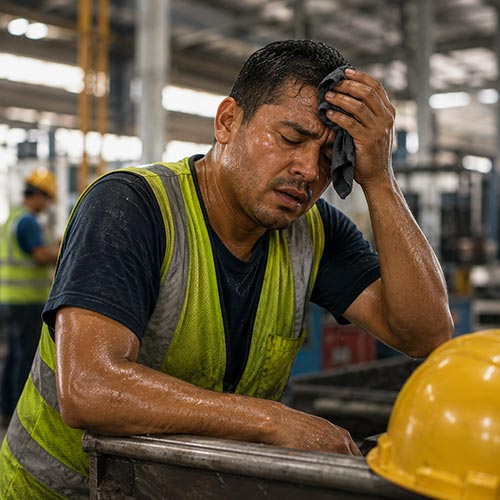
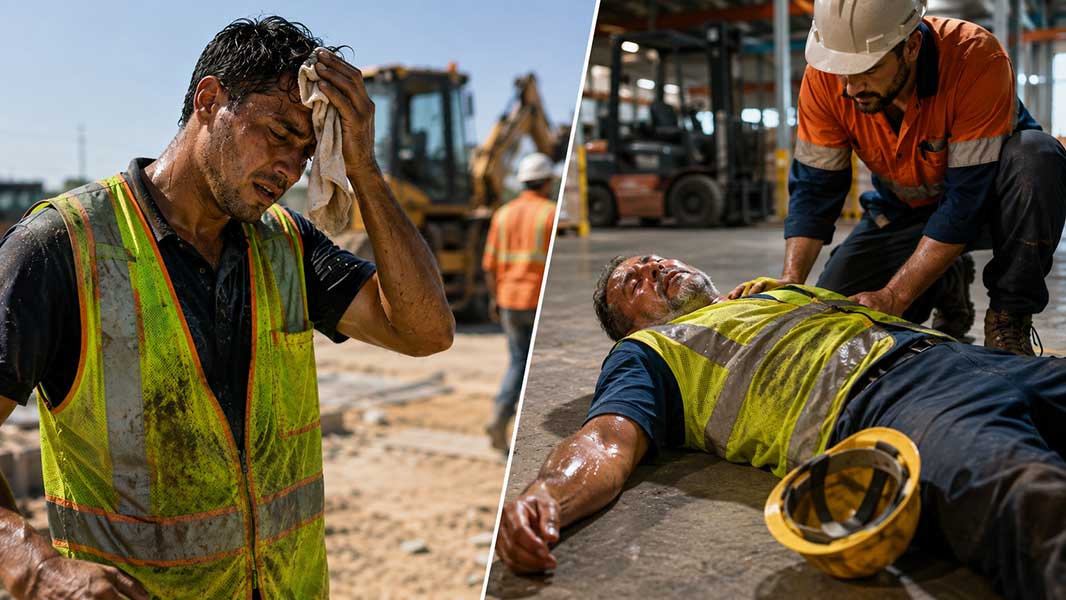
Warehouse worker experiencing heat stress, wiping sweat from forehead during a shift.

How the Body Responds to Excess Heat Exposure:

The hypothalamus, a small region in the brain, functions like a built-in thermostat and it’s constantly monitoring temperature signals from across the body. Once it senses a rise in core body temperature, it triggers two main defense mechanisms: increased blood flow to the skin and sweating. Blood vessels near the surface dilate so heat can escape through the skin, therefore cooling the blood before it circulates back to vital organs.

At the same time, sweat glands ramp up production because evaporating sweat pulls heat away from the body and this single mechanism accounts for roughly 22% of total heat loss during physical exertion. But these systems have limits. High humidity slows evaporation, heavy protective gear traps heat against the skin and prolonged exertion in extreme conditions can overwhelm the body’s ability to keep pace.

When sweating and vasodilation can no longer offset the heat load, thermoregulation starts to fail and that’s the tipping point where heat stress stops being manageable and starts becoming dangerous.

Common Causes of Heat Stress at Work:

Workplace heat stress rarely comes from a single factor. It’s usually a combination of environmental conditions, physical demands and poor planning stacking on top of each other. Here are the most common causes safety officers encounter on the job:

1. Direct Sun and High Ambient Temperature: 

Outdoor roles in construction, agriculture and landscaping expose workers directly to solar radiation, which raises skin temperature and adds to the body’s overall heat load. Combined with high ambient air temperature, this creates one of the most straightforward paths to heat stress, especially during peak sun hours between 10 a.m. and 4 p.m.

2. Poor Ventilation in Indoor Workspaces:

Bakeries, foundries, laundries and warehouses without adequate airflow trap heat with nowhere to escape. Indoor heat stress often gets overlooked because there’s no visible sun, but stagnant hot air can push core body temperature just as high as any outdoor jobsite.

3. High-Intensity Physical Labor:

Heavy physical exertion generates significant metabolic heat internally, so even a moderately warm environment can push a worker into dangerous territory faster than expected. Lifting, digging and repetitive manual tasks all add to this internal heat load, regardless of external temperature.

4. Heavy or Non-Breathable Protective Equipment:

Personal protective equipment designed to guard against chemicals, debris or sparks often traps body heat and blocks sweat evaporation entirely. This creates a frustrating safety trade-off, where gear meant to protect one hazard increases exposure to another.

5. Inadequate Hydration:

Insufficient water intake reduces the body’s ability to sweat effectively, which directly weakens its primary cooling mechanism. Dehydration compounds quickly in hot environments, turning a manageable workload into a heat-related illness risk within a short window.

6. Insufficient Rest Breaks:

Continuous work without scheduled recovery periods doesn’t give the body time to lower its core body temperature between exertion cycles. Even short breaks in shade or cool air meaningfully reduce cumulative heat strain over a shift.

7. Lack of Acclimatization for New or Returning Workers:

Workers who are new to a hot environment or returning after time away, haven’t built up the physiological adaptations that improve sweat efficiency and heat tolerance. This is why a disproportionate share of heat stress cases occur within the first few days of exposure to hot conditions.

8. High Humidity Levels:

Elevated humidity slows evaporative cooling, since sweat can’t evaporate off the skin as efficiently in moisture-saturated air. This is why a hot, humid day can feel more dangerous and cause faster heat stress onset than a hotter, drier one.

Most of these causes are preventable, which is precisely why understanding them matters more than treating symptoms after the fact.

What Is Heat Stroke? Understanding the Risk:

Heat stroke is what medical professionals classify as a true emergency and unlike heat stress, it’s not something you manage with water and shade alone. It’s defined by a core body temperature exceeding 104°F combined with central nervous system dysfunction, meaning confusion, slurred speech, seizures or loss of consciousness. At this stage, the body’s cooling mechanisms have shut down entirely. Sweating often stops altogether, which is counterintuitive to most people, because the assumption is that a hotter body sweats more.

The opposite happens here and dry, hot skin becomes one of the clearest red flags that someone has crossed from heat exhaustion into full heat stroke. This isn’t a condition that resolves with rest. It requires immediate medical intervention and every minute without treatment increases the risk of permanent damage or death.

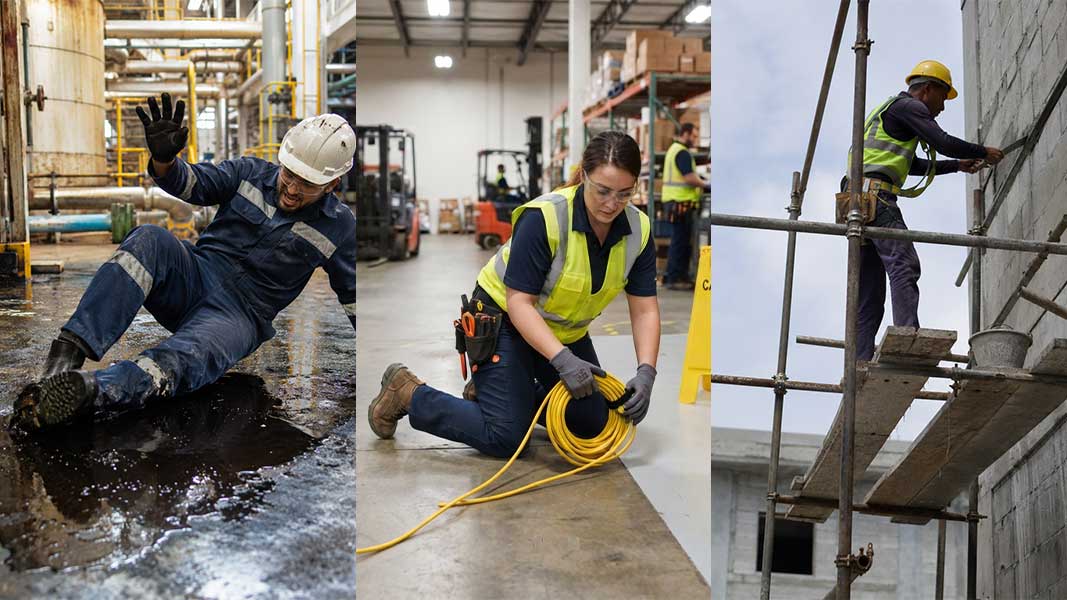
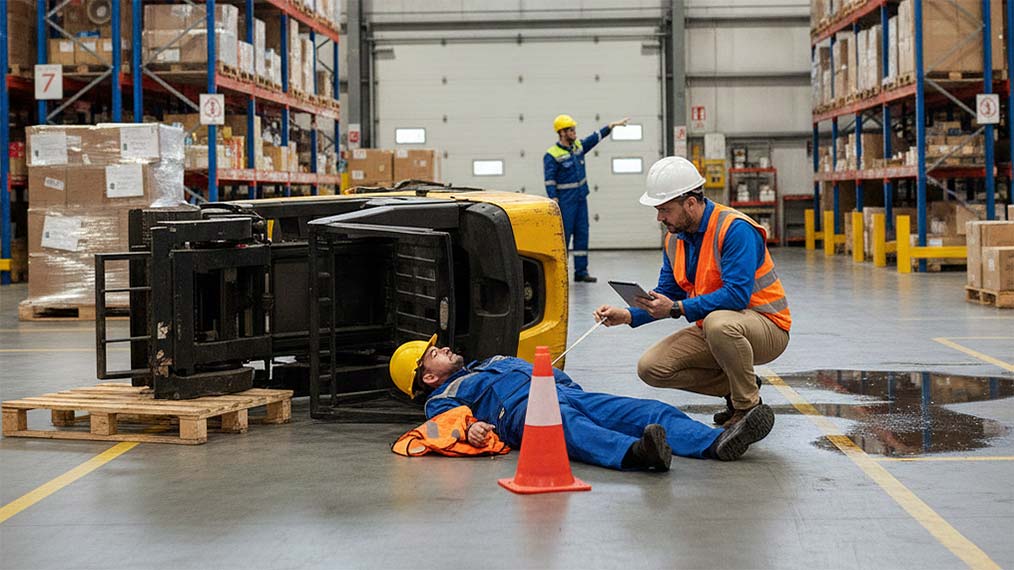
Construction worker collapsed from heat stroke while coworker checks his condition on-site.

Why Heat Stroke Is a Medical Emergency?

The numbers around heat stroke are sobering and they explain why occupational safety programs treat it as a zero-tolerance risk. Untreated heat stroke carries a mortality rate as high as 33% to 80%, according to public health researchers and once organ systems start failing, survival depends almost entirely on how fast cooling begins. The condition doesn’t stay contained to one system either. Research shows it can trigger damage across the brain, heart, liver, kidneys and muscles simultaneously and in severe cases, the intestines become permeable enough to leak toxins directly into the bloodstream, causing sepsis.

There are two recognized forms too, classic and exertional. Classic heat stroke typically affects older adults with pre-existing conditions, while exertional heat stroke strikes otherwise healthy workers pushing through strenuous labor in extreme heat, which is exactly the population most occupational safety programs need to protect.

How Heat Stroke Develops From Heat Stress:

Heat stroke doesn’t appear out of nowhere. It’s the final stage in a progression that usually starts with mild heat stress and worsens step by step as warning signs get ignored.

A worker experiencing early heat strain might feel thirsty, notice heavier sweating or develop a mild headache and if the exposure stops there, the body typically recovers on its own within a short rest period. But when exposure continues without intervention, heat stress advances into heat exhaustion, marked by heavy sweating, weakness, nausea and a rapid pulse. This is the last stage where the body is still trying to cool itself effectively.

Push past this point and the body’s thermoregulatory system essentially gives up. Sweating stops, core body temperature spikes rapidly and the brain starts showing signs of dysfunction. The entire progression from mild strain to full heat stroke can happen faster than most people expect, sometimes within an hour under extreme conditions, which is exactly why catching heat stress early matters so much in occupational safety planning.

Heat Stress vs Heat Stroke: Core Differences:

Once you understand how one condition leads to the other, the real value comes from knowing exactly how to tell them apart in the moment. Because hesitation costs time and time is the one thing you don’t have once someone crosses into heat stroke territory. The line between heat stress and heat stroke isn’t always obvious at first glance, but the signs are distinct enough that trained eyes can catch the shift before it becomes fatal. This is where occupational safety training earns its value, not in theory, but in the seconds it takes to recognize which condition you’re actually dealing with.

Comparing Symptoms Side by Side:

Here’s how the two conditions stack up against each other, symptom by symptom:

Symptom

Heat Stress / Heat Exhaustion

Heat Stroke

Skin condition

Sweaty, cool or clammy

Hot, dry or damp; sweating often stops

Mental state

Normal, though may feel dizzy

Confused, agitated, slurred speech

Body temperature

Elevated but usually below 104°F

104°F or higher

Pulse

Rapid but manageable

Rapid and strong, sometimes erratic

Consciousness

Alert and responsive

May lose consciousness or seize

Response to rest

Improves within 30 minutes

Does not improve without medical intervention

The clearest differentiator and the one every worker and supervisor should memorize, is mental status. Someone with heat stress or heat exhaustion stays coherent even if they feel weak or lightheaded, so they can still answer questions and follow instructions. Someone in heat stroke cannot. Confusion, disorientation or a sudden change in behavior signals that the brain itself is under thermal stress and that’s the point where first aid stops being enough.

Skin condition tells a similar story. Sweat means the body is still fighting to cool itself, but dry, hot skin means that fight has already been lost. Recognizing these two signals alone, mental state and skin condition, gives workers and safety officers a fast, reliable way to triage a heat-related emergency without needing a thermometer or medical training

Who Is Most at Risk on the Job Site?

Not every worker faces the same level of danger when temperatures climb and pretending otherwise leads to prevention programs that miss the people who need them most. Risk depends on a combination of job type, personal health and environmental conditions and when these three factors overlap, the danger multiplies rather than simply adds up.

Outdoor and High-Exertion Occupations:

Construction remains the industry most associated with heat-related illness and the data backs up that reputation consistently. Center for American Progress research shows construction workers accounted for 36% of all occupational heat-related deaths in the United States between 1992 and 2016, a figure driven by direct sun exposure, heavy physical labor and jobsites that often lack adequate shade or hydration access. But construction isn’t the only high-risk field. Agriculture, forestry, fishing, landscaping and roofing all expose workers to similarly extreme conditions, often for extended shifts with minimal breaks.

Indoor occupations carry real risk too and this gets overlooked far too often. Industries, foundries, warehouses and laundries without proper ventilation can push core body temperature just as high as any outdoor jobsite, because the heat has nowhere to escape.

Health Conditions That Increase Vulnerability:

Job type is only half the risk equation, because the body’s own baseline health plays an equally important role in how it handles thermal strain. Workers with cardiovascular disease face heightened danger because the heart already works harder to pump blood toward the skin for cooling and added heat strain pushes that system closer to failure.

Diabetes interferes with circulation and sweat gland function, both of which are essential for effective thermoregulation. Obesity adds another layer of risk, since higher body mass retains heat more easily and generates more metabolic heat during physical activity.

Age matters too, but not in the direction most people assume. Classic heat stroke predominantly affects older workers with existing health conditions, while exertional heat stroke strikes younger, otherwise healthy workers pushing through intense physical labor.

Certain medications compound the danger further, particularly diuretics, antihistamines and blood pressure drugs, because they interfere with the body’s natural cooling response without the worker necessarily realizing it.

None of these conditions should disqualify someone from working in the heat, but they do mean supervisors need to know who on their crew carries elevated risk, so monitoring and intervention happen before symptoms turn severe.

Environmental Factors: Heat Index and Humidity

Temperature alone tells an incomplete story and this is exactly why occupational safety experts have moved away from relying on it as the sole risk indicator.

According to OSHA, humidity plays an outsized role because it directly interferes with the body’s ability to cool itself through sweat evaporation, so a 90°F day with high humidity can be more dangerous than a 100°F day in dry air.

This is why safety professionals increasingly favor Wet Bulb Globe Temperature (WBGT) over the standard heat index. WBGT accounts for temperature, humidity, wind speed and solar radiation together, giving a far more accurate picture of actual heat strain on the body, whereas the heat index only factors in temperature and humidity from a shaded reference point.

Radiant heat sources, whether from direct sunlight or industrial equipment like furnaces and boilers, add further load that basic temperature readings simply don’t capture. For any workplace serious about preventing heat-related illness, WBGT monitoring isn’t a nice-to-have. It’s the difference between guessing at risk and actually measuring it.

First Aid Response: Heat Stress vs Heat Stroke:

Recognizing the difference between heat stress and heat stroke only matters if it changes what you do next. First aid for one condition looks nothing like first aid for the other and using the wrong approach wastes precious time. This section breaks down exactly what to do at each stage, so the response matches the severity of what’s actually happening to the worker.

Immediate Steps for Heat Stress Cases:

When someone shows early signs of heat stress, such as heavy sweating, mild cramps, fatigue or a headache, the priority is straightforward: stop the exposure and start cooling immediately. Move the worker to shade or an air-conditioned space right away, because continuing to work through these symptoms almost always makes things worse. Loosen or remove any heavy protective clothing, since trapped heat prevents the body from cooling naturally. Offer small, frequent sips of water or an electrolyte drink, but avoid forcing fluids if the person feels nauseated.

Applying cool, wet cloths to the skin or having them sit in a cool area helps speed up recovery. According to OSHA and NIOSH guidance, most workers with heat exhaustion improve within 30 minutes when these steps are followed correctly. If symptoms persist beyond that window, worsen or the person starts vomiting repeatedly, treat it as a signal to escalate toward medical attention rather than waiting it out.

Emergency Actions for Suspected Heat Stroke:

The moment someone shows confusion, slurred speech, seizures or loses consciousness, first aid shifts from supportive care to active, aggressive cooling. OSHA recommends immersing the worker in cold water or an ice bath immediately, since this is the fastest way to bring core body temperature down in an emergency.

If a full immersion setup isn’t available, placing ice or cold, wet towels on the head, neck, armpits and groin achieves a similar effect, because these areas allow rapid heat transfer away from the body’s core. Remove outer layers of clothing, particularly heavy protective gear and use fans to keep air circulating around the person while cooling continues. Do not attempt to give water or fluids if the person is unconscious or too confused to swallow safely, since this creates a choking risk.

Never leave someone with suspected heat stroke alone at any point, because the condition can deteriorate within minutes and having someone monitor breathing and responsiveness constantly is critical until help arrives.

When to Call for Emergency Medical Help:

Call 911 the moment you suspect heat stroke and don’t wait to see if symptoms improve first. This is one situation where hesitation directly increases risk, since heat stroke carries a mortality rate that climbs sharply with every minute cooling is delayed. Confusion, slurred speech, seizures or unconsciousness are all immediate triggers for emergency medical services, no exceptions. Even with heat stress or heat exhaustion, call for medical help if the person vomits repeatedly, doesn’t improve within 30 minutes of cooling or is unable to drink fluids on their own.

The general rule that safety professionals rely on captures this well: when in doubt, cool the worker and call for help anyway. Guessing wrong in the direction of caution costs nothing. Guessing wrong in the other direction can cost a life.

Frequent Asked Questions (FAQs):

What is the exact core body temperature threshold that defines heat stroke?

Heat stroke is clinically defined at a core body temperature exceeding 104°F (40°C), combined with central nervous system dysfunction such as confusion, seizures or loss of consciousness. Temperature alone without neurological symptoms is classified as severe heat exhaustion, not heat stroke.

Can heat stress cause permanent organ damage even without progressing to heat stroke?

Mild to moderate heat stress typically resolves without lasting damage once the body cools and rehydrates. However, repeated, unaddressed heat strain episodes have been linked to chronic kidney disease in outdoor workers, particularly in agricultural populations with sustained occupational heat exposure.

Construction workers accounted for approximately 36% of all occupational heat-related deaths in the United States between 1992 and 2016, making it the single highest-risk industry sector for fatal heat exposure.

Why does heat stroke cause dry skin instead of increased sweating?

As core temperature rises uncontrollably, the body’s thermoregulatory system fails completely, shutting down sweat gland function. This is why hot, dry skin is a hallmark diagnostic sign that distinguishes heat stroke from heat exhaustion, where sweating remains active.

How quickly can heat stress progress to heat stroke under extreme conditions?

The progression can occur within an hour or less during intense physical exertion in high WBGT conditions, especially for workers who are not acclimatized. This rapid timeline is why continuous monitoring, not just periodic checks, is critical in high-risk environments.

Cold water immersion or an ice bath is the fastest and most effective method to lower core temperature in an emergency. Where immersion isn’t feasible, applying ice packs to the neck, armpits and groin achieves comparable rapid cooling.

How does acclimatization reduce heat stroke risk?

Acclimatization allows the body to gradually adapt by increasing sweat rate efficiency and reducing the concentration of salt lost through sweat over 7 to 14 days of progressive heat exposure. Workers new to hot environments face significantly higher risk during this adjustment period.

Is heat stroke reversible if treatment begins immediately?

Rapid cooling within the first 30 minutes significantly improves survival odds and reduces the likelihood of permanent organ damage. Delayed treatment sharply increases mortality risk, since outcomes correlate directly with how quickly core temperature is brought down.

Inquiry Form