
Fall Arrest System: Types, Components and Safe Use

A fall arrest system is a critical form of personal fall protection designed to stop a worker safely after an accidental fall from height. It plays an essential role in controlling fall-related hazards across construction sites, oil and gas facilities, industrial plants, warehouses and maintenance operations. A properly selected system typically combines a full-body safety harness, energy-absorbing lanyard or self-retracting lifeline, suitable connectors and a certified anchorage point. However, effective fall protection involves more than wearing a harness. Employers must consider fall clearance distance, arrest forces, equipment compatibility, inspection requirements and emergency rescue arrangements. Understanding these factors helps organizations prevent serious injuries and establish safer working-at-height practices.

What Is a Fall Arrest System?

A fall arrest system is a safety arrangement designed to protect workers when a fall from height cannot be prevented through other control measures. It works by stopping a falling worker before they strike the ground, a lower platform or another obstruction.
Typically, a personal fall arrest system (PFAS) consists of a full-body safety harness, connecting device and suitable anchorage point. However, its effectiveness depends on selecting compatible equipment, calculating adequate fall clearance and ensuring that the system can safely withstand the forces generated during a fall. Unlike fall restraint equipment, which prevents workers from reaching an edge, a fall system allows movement within a work area but arrests an accidental fall.

Purpose of a Personal Fall Arrest System:

The primary purpose is to minimize the consequences of an accidental fall when working at height. It is particularly important where workers operate near unprotected edges, elevated platforms, roof openings or other locations with significant fall exposure.

The system connects the worker to a suitable anchorage through a harness and an appropriate connecting device. Therefore, when a fall occurs, the system limits the worker’s downward movement and reduces the impact forces transmitted to the body. It also helps prevent contact with lower levels or surrounding structures. However, a PFAS should be used alongside proper risk assessment, equipment inspection and a planned rescue procedure.

When Is Personal Fall Protection Required?

Personal fall protection is necessary when workers face a risk of falling from an elevated position and the hazard cannot be adequately eliminated or controlled through higher-level protective measures.
Common situations include roof maintenance, steel structure erection, scaffolding work, industrial equipment servicing and activities near unprotected platforms or openings. Specific legal requirements depend on the applicable jurisdiction, workplace conditions and nature of the task.

For example, OSHA construction regulations generally require protection at unprotected sides and edges 6 feet (1.8 meters) or more above a lower level, subject to specified provisions and exceptions. However, this threshold should not be treated as a universal safe working limit. A site-specific risk assessment must determine the appropriate protective measures.

How Does a Fall Arrest System Work?

This system operates through a coordinated combination of anchorage, connecting devices and body support equipment. Each component performs a specific function during an accidental fall, from securing the worker to controlling the forces generated during arrest.

The process begins when the worker loses footing or balance and enters free fall. Subsequently, the connecting device engages its braking or energy-absorption mechanism to slow and stop the descent. However, the effectiveness of this process depends on several technical factors, including free-fall distance, deceleration distance, anchorage position, equipment compatibility and available clearance below the worker. Understanding these factors is essential for selecting and using fall protection equipment safely.

Understanding the Fall Arrest Process:

The fall arrest process involves several connected stages that work together to stop a falling worker safely.

  1. Fall initiation: The worker loses balance, footing or support and begins falling.
  2. Free fall: The worker descends before the fall arrest system begins to engage.
  3. System activation: The energy absorber deploys or the SRL braking mechanism engages.
  4. Deceleration: The system slows the worker’s downward movement by managing the generated forces.
  5. Fall arrest: The worker is suspended by the harness and connected equipment after the descent stops.

Each stage contributes to controlling fall-related injuries. However, the system must be correctly configured because excessive free fall, unsuitable anchorage or insufficient clearance can compromise its performance. Furthermore, a prompt rescue response is necessary once a worker remains suspended.

Free Fall and Arrest Distance:

Free-fall distance refers to the vertical distance a worker travels before the protective equipment begins to engage.

Arrest distance, commonly assessed through deceleration distance, describes the additional downward movement required to bring the worker to a complete stop.

Both measurements are important when determining whether sufficient clearance exists beneath the working position. For example, a longer lanyard, low anchorage point or delayed engagement can increase the total distance required to stop a fall.

Therefore, employers must consider the connecting device specifications, harness attachment point, worker height and required safety margins during clearance calculations. Incorrect assessments can result in a worker striking a lower surface despite wearing approved protective equipment.

Fall Forces and Impact on the Human Body:

When a worker falls, gravitational acceleration increases their downward velocity, generating significant forces when the protective equipment engages. These forces can cause serious injuries if components are incorrectly selected, improperly fitted or connected to an unsuitable anchorage.

A properly designed full-body harness distributes arrest forces across designated body areas, including the thighs, pelvis, chest and shoulders. Meanwhile, an energy absorber helps reduce the peak forces transmitted through the connecting equipment. However, excessive arrest forces can still cause internal injuries, fractures and other trauma. Workers may also experience suspension intolerance after being left hanging in a harness. Therefore, equipment compatibility, manufacturer-rated performance and prompt rescue arrangements are essential elements of an effective fall protection program.

Key Components of Personal Fall Protection Equipment:

A personal fall protection arrangement depends on several interconnected components, each designed to perform a specific safety function. These include the full-body harness, connecting devices, energy absorbers, lifelines, anchorage connectors and mechanical connectors. However, having individually certified components does not automatically guarantee a safe arrangement.

Every component must be compatible with the others and suitable for the intended working conditions. For instance, an incorrect connector or unsuitable anchor point can compromise the entire setup during an incident. Therefore, understanding the function, limitations and inspection requirements of each component is essential before selecting or using protective equipment at a workplace.

Full Body Safety Harness:

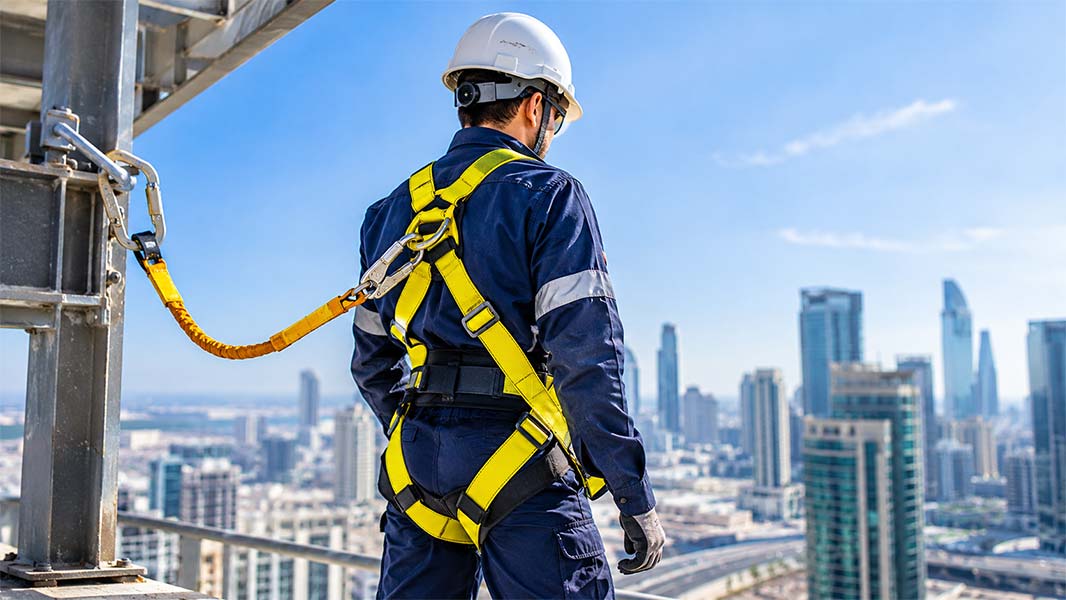
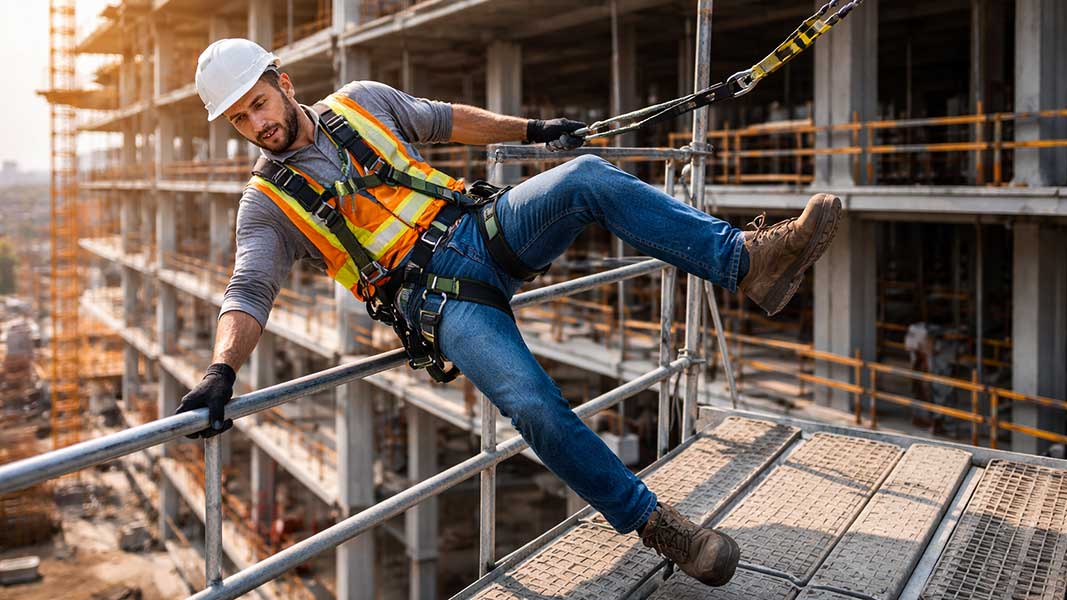
A full-body safety harness is the primary body-support component used in personal fall protection. It consists of interconnected shoulder, chest, waist and leg straps designed to distribute arrest forces across designated areas of the body. Most harnesses intended for fall arrest include a dorsal D-ring positioned between the shoulder blades for connecting an appropriate lanyard or self-retracting lifeline. Some models also provide additional attachment points for specific applications, such as rescue or work positioning. However, not every D-ring is suitable for arresting falls, so workers must follow the manufacturer’s instructions. Correct fitting is equally important because loose, twisted or incorrectly adjusted straps can increase injury risks during an incident.

Lanyards and Energy Absorbers:

A fall arrest lanyard connects the worker’s harness to an anchorage system or lifeline. It is generally manufactured using synthetic webbing, rope or specialized materials designed to withstand the loads associated with fall protection. Energy-absorbing lanyards incorporate a tear-webbing or similar mechanism that progressively deploys during a fall, reducing the peak arrest forces transmitted to the worker. Double-leg lanyards can also support continuous connection when moving between suitable anchorage points, provided the manufacturer’s instructions are followed. However, workers must consider lanyard length, free-fall limitations, clearance requirements and compatibility with the anchorage. An ordinary positioning or restraint lanyard must never be assumed suitable for fall arrest.

Self-Retracting Lifelines (SRLs):

A self-retracting lifeline (SRL) is a mechanical fall protection device that automatically extends and retracts a lifeline as the worker moves within the permitted working area. It contains an internal braking mechanism that locks the line when a sudden acceleration occurs, such as during an accidental fall. Depending on the model, SRLs use a webbing or wire-rope lifeline and may be suitable for different anchorage positions and working environments. Some specialized models are designed for leading-edge applications or overhead use. However, not all SRLs are approved for every configuration. Workers must verify the device classification, manufacturer restrictions, anchorage requirements and inspection condition before use.

Vertical and Horizontal Lifelines:

Vertical and horizontal lifelines provide connection points for workers who need to move along elevated structures while remaining protected against falls. A vertical lifeline typically runs between a secure upper anchorage and a lower termination point, allowing compatible rope grabs or travelling devices to follow the worker’s movement. In contrast, a horizontal lifeline is installed between two or more anchorage points and supports movement along a designated work area. Horizontal systems may be flexible or rigid and require careful engineering because fall arrest forces can increase significantly at their end anchorages. Therefore, system design, allowable user numbers, deflection, anchorage strength and manufacturer specifications must be evaluated before installation.

Anchorage Connectors and Anchor Points:

An anchorage point is the structural location to which a fall system is secured, while an anchorage connector provides the interface between the structure and the connecting device. Common examples include engineered roof anchors, beam clamps, structural tie-off connectors and certified anchorage plates. These components must be suitable for the expected loading direction and the specific fall protection arrangement.

For example, an anchor designed for vertical loading may not be suitable for a horizontal or leading-edge application. Under OSHA’s general PFAS criteria in 29 CFR 1926.502(d)(15), anchorages must support at least 5,000 pounds (22.2 kN) per attached employee or be designed, installed and used under the supervision of a qualified person as part of a complete system with a safety factor of at least two. Therefore, anchorage selection must never rely on visual appearance alone.

Connectors, Hooks and Carabiners:

Connectors, including locking snap hooks and carabiners, join individual fall protection components to create a continuous connection between the worker and the anchorage. They are generally manufactured from high-strength steel or aluminium and incorporate locking mechanisms designed to prevent accidental disengagement. However, connector compatibility is critical because incorrect connections can cause roll-out, side loading or gate loading, potentially resulting in equipment failure. Workers must ensure that connectors are properly locked and attached to approved connection points. They should also avoid connecting hooks directly to incompatible D-rings, webbing loops or other connectors unless the manufacturer specifically permits that configuration. Regular inspection for corrosion, deformation, cracks and defective locking mechanisms is equally important.

Types of Personal Fall Protection Systems:

Different fall protection arrangements are available to accommodate the structural design, working conditions and movement requirements of elevated workplaces. The appropriate configuration depends on factors such as anchorage availability, work positioning, potential fall distance, number of workers and the nature of the activity. For example, construction workers may require individual protective equipment, whereas maintenance personnel working along industrial structures may benefit from horizontal lifelines or rigid rail systems. Each arrangement has specific installation, inspection and operational requirements. Therefore, selection should follow a site-specific risk assessment and consideration of the manufacturer’s technical specifications. The objective is to provide reliable protection without introducing additional hazards during installation, use or rescue.

Personal Fall Arrest Systems (PFAS):

A PFAS is an individual protective arrangement designed to stop a worker following an accidental fall. It generally consists of a full-body harness, connecting device and suitable anchorage point. Depending on the application, the connecting device may include an energy-absorbing lanyard or self-retracting lifeline (SRL). PFAS is commonly used in construction, industrial maintenance, oil and gas operations and other activities where workers are exposed to unprotected edges or elevated surfaces. However, every component must be compatible and correctly configured to control arrest forces and prevent contact with lower levels. Employers must also establish equipment inspection procedures and ensure that an effective rescue plan is available before work begins.

Vertical Lifeline Systems:

A vertical lifeline provides protection for workers moving up or down elevated structures, such as towers, ladders, masts and vertical access systems. It generally consists of a securely anchored vertical rope or wire lifeline and a compatible rope grab or travelling fall arrester connected to the worker’s full-body harness. The travelling device follows the worker’s movement and locks when sudden downward movement occurs during a fall. This arrangement allows workers to maintain continuous protection while climbing or descending. However, the lifeline must be compatible with the travelling device, properly anchored and protected against abrasion or sharp edges. Installation, user limitations and inspection must follow the manufacturer’s specifications and applicable safety requirements.

Horizontal Lifeline Systems:

A horizontal lifeline allows workers to move along an elevated working area while remaining connected to a continuous protective arrangement. It typically consists of a flexible wire rope, synthetic lifeline or rigid track installed between engineered anchorage points. Workers connect their full-body harnesses through compatible travelling devices, lanyards or self-retracting lifelines. These installations are commonly used on industrial rooftops, steel structures, aircraft hangars and maintenance platforms where workers need lateral movement. However, flexible horizontal lifelines require careful engineering because line deflection and dynamic loading during a fall can generate substantial forces at the end anchorages. Therefore, their design, installation and use must be supervised by a qualified person and account for the permitted number of users, required clearance and rescue arrangements.

Rigid Rail Protection Systems:

A rigid rail arrangement uses a fixed structural track or rail to provide a controlled connection for workers operating at height. Unlike flexible lifelines, the rigid track limits horizontal deflection and provides a defined travel path for compatible trolleys or connecting devices. These installations are particularly useful in industrial facilities, aircraft maintenance hangars, loading bays and manufacturing plants where workers repeatedly perform tasks in elevated positions. The trolley moves along the rail as the worker changes position, maintaining a continuous connection to the protective arrangement. However, the supporting structure, rail connections and configuration must be engineered for the intended loading conditions. Regular inspection is also necessary to identify mechanical wear, damaged components and defects in the supporting structure.

Overhead Protection Systems:

An overhead arrangement uses an anchorage or track positioned above the worker to provide protection during elevated activities. It may incorporate an overhead horizontal lifeline, rigid rail, travelling trolley or self-retracting lifeline connected to a full-body harness. Keeping the connection above the worker can help reduce free-fall distance and minimize the likelihood of swing falls when the equipment is correctly designed. These installations are commonly used in vehicle maintenance workshops, industrial production facilities, loading areas and aircraft servicing hangars. However, the overhead structure must have adequate load-bearing capacity, and the connection must remain within the permitted working range. Design considerations must also include headroom, required clearance, trolley movement and emergency rescue arrangements.

Fall Arrest vs Fall Restraint Systems:

Fall arrest and fall restraint are two different approaches to protecting workers from height-related hazards. Although both use personal protective equipment and suitable anchorage arrangements, their operating principles differ. A restraint arrangement prevents workers from reaching an edge or hazardous location where a fall could occur. In contrast, an arrest arrangement allows access to the working area but stops the worker if an accidental fall happens. This distinction is important when selecting suitable controls for construction, industrial maintenance and other elevated activities. Employers should priorities preventing access to fall hazards wherever reasonably practicable. However, when exposure cannot be eliminated through restraint, a properly designed arrest arrangement may be necessary.

Key Differences in Their Functions:

The main difference between these approaches is whether they prevent a fall from occurring or stop it after it begins.

A restraint arrangement uses a suitable harness, restraint line and anchorage to restrict the worker’s movement before reaching an exposed edge. Consequently, the worker cannot enter the fall hazard area when the equipment is correctly configured.

An arrest arrangement, on the other hand, permits movement within a designated working area but activates when an accidental fall occurs. It uses components such as energy-absorbing lanyards or self-retracting lifelines to stop the descent.

Therefore, restraint focuses on preventing exposure, whereas arrest focuses on limiting the consequences of an accidental fall.

When to Use Fall Arrest or Fall Restraint?

Fall restraint should generally be selected when workers can complete their tasks without needing to access an exposed edge or other fall hazard. For example, a properly configured restraint arrangement can prevent maintenance personnel from reaching an unprotected rooftop perimeter. However, when workers must operate beyond the reach of this equipment, a fall arrest arrangement may be required. Activities such as steel structure installation, tower maintenance and work on elevated industrial equipment may involve this type of exposure. Selection should follow the hierarchy of controls, starting with eliminating work at height where possible and prioritizing collective protection measures such as guardrails. Where personal equipment is necessary, employers must assess anchorage suitability, clearance, component compatibility and rescue arrangements before authorizing the work.

Fall Protection Requirements and Standards:

Personal fall protection equipment must meet applicable occupational safety regulations and recognized technical standards to provide reliable protection during work at height. These requirements address equipment performance, anchorage strength, system configuration, inspection, worker competency and emergency rescue. However, regulatory obligations differ between countries and jurisdictions, so organizations must identify the requirements applicable to their operations. Internationally, OSHA regulations provide detailed criteria for PFAS, while the ANSI/ASSP Z359 series establishes technical requirements for protective equipment and program management. In the UAE, employers must also comply with applicable federal occupational health and safety legislation and relevant emirate-level requirements. Understanding these frameworks helps organizations select compliant equipment and implement effective working-at-height procedures.

OSHA Fall Protection Requirements:

The Occupational Safety and Health Administration (OSHA) establishes specific requirements for fall protection in the United States through regulations covering construction and general industry.

Under OSHA construction standard 29 CFR 1926.502, PFAS must be designed and used to prevent workers from contacting lower levels during an arrested fall. The regulation also establishes requirements for anchorage capacity, connecting components, lifelines, inspection and maximum arresting forces. For example, anchorages must support at least 5,000 pounds (22.2 kN) per attached employee or form part of a complete system designed under qualified-person supervision with a minimum safety factor of two.

OSHA construction regulations generally require fall protection at unprotected sides and edges 6 feet (1.8 meters) or more above a lower level, subject to specific exceptions. These provisions are particularly relevant to employers and contractors working under US regulatory requirements.

ANSI and International Safety Standards:

The ANSI/ASSP Z359 series is a recognized collection of technical standards covering fall protection equipment, system design, training and program management. It addresses important aspects such as full-body harnesses, connecting devices, energy-absorbing lanyards, self-retracting devices, anchorage systems and rescue arrangements.

For example, ANSI/ASSP Z359.2 addresses the minimum requirements for a comprehensive managed fall protection program, while Z359.4 covers assisted-rescue and self-rescue systems. Other relevant international standards include EN 361 for full-body harnesses, EN 355 for energy absorbers, EN 360 for retractable-type fall arresters and EN 795 for anchor devices.

However, compliance with an equipment standard alone does not establish that an entire fall arrest system is suitable for a particular workplace. Employers must verify equipment certification, compatibility, installation requirements and applicable local regulations before use.

UAE Regulations for Working at Height:

In the UAE, employers must manage working-at-height hazards in accordance with applicable occupational health and safety legislation and the requirements of the relevant emirate or regulatory authority.

Federal Ministerial Resolution No. 44 of 2022 establishes occupational health and safety obligations for employers and workers, including compliance with relevant procedures issued by competent authorities.

In Abu Dhabi, the Abu Dhabi Occupational Safety and Health System Framework (ADOSH-SF) includes Code of Practice 23.0, Working at Height. Its Version 4.1, issued in February 2026, addresses fall prevention, equipment selection, training, inspection and rescue arrangements.

Employers must ensure that work at height is properly planned, supervised and supported by suitable protection measures. Furthermore, collective protection should take priority over personal fall protection wherever practicable. Therefore, organizations operating in Dubai, Abu Dhabi, Sharjah and other emirates must identify and follow the requirements applicable to their specific workplaces and projects.
Common Fall Arrest System Hazards and Mistakes:

A fall arrest system can fail to provide adequate protection when equipment is incorrectly selected, improperly installed or used without proper planning. Even certified components can create serious risks if they are incompatible or unsuitable for the working environment. Common problems include incorrect harness fitting, weak anchorage, insufficient fall clearance and failure to identify damaged equipment. In addition, organizations sometimes overlook the importance of emergency rescue arrangements and worker competency. These mistakes can lead to equipment failure, contact with lower surfaces, severe injuries or delayed rescue following an arrested fall. Therefore, employers must identify potential weaknesses through risk assessments, equipment inspections, practical training and effective supervision. Understanding these common hazards helps organizations improve fall protection arrangements and reduce the likelihood of preventable incidents.

Incorrect Harness Selection and Fitting:

Selecting an unsuitable full-body harness or wearing it incorrectly can compromise the effectiveness of a fall arrest system. Harnesses must be appropriate for the intended application, compatible with the connecting device and suitable for the worker’s body size. Loose shoulder straps, twisted webbing, incorrectly positioned leg straps or an improperly secured chest strap can affect how arrest forces are distributed during a fall. Furthermore, workers should never assume that all harnesses have identical attachment points or load ratings. Before use, the harness must be adjusted according to the manufacturer’s instructions, with the dorsal attachment point correctly positioned. Employers should also consider specialized requirements, including additional attachment points for rescue or work positioning, where applicable.

Improper Anchorage and Connection:

An unsuitable anchorage point or incorrectly connected component can undermine the entire fall arrest arrangement. Common mistakes include attaching equipment to unverified structural members, using connectors that are incompatible with the harness or selecting anchor points that cannot withstand the anticipated loading conditions. Incorrect connections may also create roll-out, side-loading or gate-loading hazards. Additionally, connecting below the permitted anchorage position can increase free-fall distance and the clearance required to arrest a fall. Employers must therefore verify anchorage suitability, structural capacity and loading direction before work begins. All connectors should be compatible, fully locked and used in accordance with manufacturer instructions. Where necessary, a qualified person should assess and approve the complete anchorage arrangement.

Inadequate Fall Clearance:

Insufficient fall clearance is a serious hazard because a worker may strike the ground, equipment or another obstruction before the fall arrest system can stop the descent. This problem often results from incorrect calculations or failure to consider the actual system configuration. Required clearance depends on factors such as free-fall distance, deceleration distance, harness D-ring movement, worker height, connecting device specifications and the position of the anchorage point. Additional clearance may also be necessary to account for system deflection and manufacturer-specified safety margins. Therefore, employers must calculate the required clearance before selecting or using fall protection equipment. A system should never be considered suitable simply because a worker is connected to an approved lanyard or self-retracting lifeline.

Failure to Inspect Damaged Equipment:

Using damaged or deteriorated fall protection equipment can result in component failure during an accidental fall. Harness webbing may develop cuts, burns, chemical damage or weakened stitching, while metal connectors can become deformed, corroded or develop defective locking mechanisms. Energy absorbers may also show signs of previous deployment, indicating that the equipment is no longer suitable for use. Workers should inspect their equipment before each use and remove any component that shows damage, abnormal wear or signs of previous fall arrest. Furthermore, periodic inspections must be conducted by a competent person at intervals specified by the manufacturer and applicable requirements. Equipment exposed to a fall or suspected damage must be removed from service until it has been assessed and formally cleared for reuse, where permitted.

Lack of Rescue Planning and Training:

A fall arrest system does not eliminate the need for an emergency rescue plan. After a fall has been arrested, a worker may remain suspended in the harness and experience serious medical complications if rescue is delayed. Organizations sometimes rely entirely on external emergency services without considering site access, rescue equipment or the time required to reach the suspended worker. This can create additional risks during an incident. Employers must establish a site-specific rescue procedure before work begins, identify trained rescuers and ensure suitable rescue equipment is available. Workers should understand how to raise an alarm and communicate an emergency. Regular practical exercises also help verify that rescue arrangements are realistic, effective and appropriate for the working environment.

Conclusion:

A properly selected and implemented fall arrest system plays an important role in protecting workers from serious injuries during work at height. However, effective fall protection requires more than providing a harness and connecting lanyard. Employers must assess workplace hazards, select compatible equipment, verify anchorage suitability and calculate adequate fall clearance before work begins. Equally important, regular equipment inspections, practical worker training and effective supervision help maintain system reliability. Emergency rescue arrangements must also be established because an arrested fall can still create serious risks if a suspended worker is not rescued promptly. By integrating these requirements into workplace risk assessments and safe work procedures, organizations can strengthen their working-at-height controls and reduce preventable incidents. Eduskills Training supports professional development in occupational health and safety through practical, industry-relevant training that helps build workplace safety knowledge and competency.

Frequent Asked Questions (FAQs):

What is the difference between fall arrest distance and fall clearance distance?

Fall arrest distance refers to the distance travelled before the system completely stops the worker. Fall clearance distance is the total vertical space required below the worker to prevent contact with a lower surface, including free fall, deceleration, equipment movement and an appropriate safety margin.

How is the required fall clearance distance calculated?

The calculation considers free-fall distance, deceleration distance, harness D-ring movement, worker height and the applicable equipment specifications. Additional clearance may be required for system deflection and safety margins. Always use the manufacturer’s calculation method for the specific equipment configuration.

What is the maximum permitted free-fall distance in an OSHA-compliant PFAS?

Under OSHA construction standard 29 CFR 1926.502(d), PFAS must limit free fall to no more than 6 feet (1.8 meters), subject to the regulation’s specific provisions. Equipment configuration must also satisfy the applicable arresting-force and deceleration requirements.

What is the minimum anchorage strength for a PFAS?

Under OSHA construction requirements, each anchorage must support at least 5,000 pounds (22.2 kN) per attached employee. Alternatively, it must be designed, installed and used under a qualified person’s supervision as part of a complete system with a safety factor of at least two.

Why is a full-body harness required for fall arrest?

A full-body harness distributes fall arrest forces across designated areas of the body, including the thighs, pelvis, chest and shoulders. It also helps maintain an upright or near-upright suspended position when correctly fitted, reducing the risk of serious injury compared with unsuitable body-support equipment.

How often should fall arrest equipment be inspected?

Workers should inspect fall protection equipment before each use. In addition, periodic detailed inspections must be performed by a competent person at intervals specified by the manufacturer and applicable regulations. Equipment exposed to a fall or suspected damage must be removed from service immediately.

What is the purpose of a dorsal D-ring on a safety harness?

The dorsal D-ring is generally positioned between the shoulder blades and serves as the primary attachment point for many personal fall arrest configurations. However, the suitability of any attachment point depends on the harness design, manufacturer instructions and intended application.

What factors determine the selection of an appropriate fall arrest system?

Selection depends on the work activity, potential fall distance, anchorage availability, clearance below the worker, equipment compatibility, environmental conditions, number of users and rescue arrangements. A documented risk assessment should establish which system is suitable for the specific task.

Are fall arrest systems suitable for all work-at-height activities?

No. Fall arrest systems are not automatically the best solution for every elevated task. Employers should first consider eliminating work at height and prioritizing collective protection, such as guardrails or suitable working platforms. Personal fall arrest should be selected where the risk assessment identifies it as an appropriate control.

What should a fall rescue plan include?

A fall rescue plan should identify rescue methods, trained personnel, suitable rescue equipment, communication arrangements, access routes and emergency responsibilities. It must also address how a suspended worker will be recovered promptly and safely without exposing rescuers to additional fall hazards.

Inquiry Form